Must-Read Brain Books of the Year, Forbes
Bestselling Business Books of the Year, Business Insider
Best Books of the Year, MIT Technology Review
What should we do, or leave undone, in a day or a lifetime? How much messiness should we accept? What balance of the new and familiar is the most fulfilling? These may seem like uniquely human quandaries, but they are not. Computers, like us, confront limited space and time, so computer scientists have been grappling with similar problems for decades. And the solutions they’ve found have much to teach us.
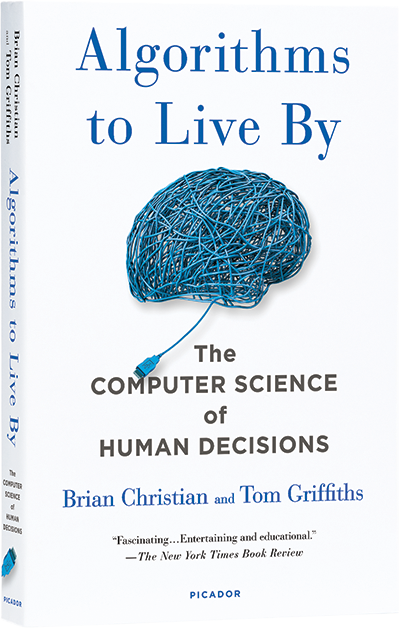
In a dazzlingly interdisciplinary work, Brian Christian and Tom Griffiths show how algorithms developed for computers also untangle very human questions. They explain how to have better hunches and when to leave things to chance, how to deal with overwhelming choices and how best to connect with others. From finding a spouse to finding a parking spot, from organizing one’s inbox to peering into the future, Algorithms to Live By transforms the wisdom of computer science into strategies for human living.
PRAISE
“Compelling and entertaining, Algorithms to Live By is packed with practical advice about how to use time, space, and effort more efficiently. And it’s a fascinating exploration of the workings of computer science and the human mind. Whether you want to optimize your to-do list, organize your closet, or understand human memory, this is a great read.”
— Charles Duhigg
author of The Power of Habit
“In this remarkably lucid, fascinating, and compulsively readable book, Christian and Griffiths show how much we can learn from computers. We’ve all heard about the power of algorithms—but Algorithms to Live By actually explains, brilliantly, how they work, and how we can take advantage of them to make better decisions in our own lives.”
— Alison Gopnik
coauthor of The Scientist in the Crib
“I’ve been waiting for a book to come along that merges computational models with human psychology—and Christian and Griffiths have succeeded beyond all expectations. This is a wonderful book, written so that anyone can understand the computer science that runs our world—and more importantly, what it means to our lives.”
— David Eagleman
author of Incognito: The Secret Lives of the Brain
“A remarkable book... A solid, research-based book that’s applicable to real life. The algorithms the authors discuss are, in fact, more applicable to real-life problems than I’d have ever predicted.... It’s well worth the time to find a copy of Algorithms to Live By and dig deeper.”
— Forbes
“By the end of the book, I was convinced. Not because I endorse the idea of living like some hyper-rational Vulcan, but because computing algorithms could be a surprisingly useful way to embrace the messy compromises of real, non-Vulcan life.”
— The Guardian (UK)
“I absolutely reveled in this book... It's the perfect antidote to the argument you often hear from young math students: ‘What's the point? I'll never use this in real life!’... The whole business, whether it's the relative simplicity of the 37% rule or the mind-twisting possibilities of game theory, is both potentially practical and highly enjoyable as presented here. Recommended.”
— Popular Science (UK)
Best Science Books of the Year, Amazon
#1 Amazon Bestseller in Science
Top Picks in Science, Barnes & Noble
#1 Audible Bestseller in Nonfiction
Photo Credit: Henry Young
Brian Christian is a Research Fellow at the Center for Human-Compatible AI at UC Berkeley, and holds a PhD in cognitive science and machine learning from the University of Oxford. His research on AI alignment and computational cognitive science has appeared in journals such as PNAS and Cognitive Science and at conferences including NeurIPS and ICLR, and has been covered by Nature, The New York Times, and The Guardian. He is also the author of The Most Human Human and The Alignment Problem, which won the National Academies' Excellence in Science Communication Award; his writing has appeared in The New Yorker, The Atlantic, and Wired, and his books have been translated into twenty languages. He lives in San Francisco.
Tom Griffiths is the Henry R. Luce Professor of Information Technology, Consciousness, and Culture at Princeton University, where he holds appointments in psychology and computer science and co-directs Data and Intelligent Systems, Princeton's academic unit for AI and data science. He has published more than 500 scientific papers on topics ranging from cognitive psychology to artificial intelligence, and is also the author of The Laws of Thought. His honors include a Guggenheim Fellowship and the National Academy of Sciences Troland Research Award. He lives in Princeton, New Jersey.


